For Prospective Students
If you are a high school student wondering whether astrophysics might be for you, or an Allegheny student looking for a research experience, I would love to hear from you at jalombar at allegheny dot edu. If you are thinking about joining the group, you may also be wondering what projects Allegheny undergraduates have worked on and what career skills you can develop through astrophysics research. The rest of this page gives a sense of the work students have done in my group, the skills they have built, and the many directions they have taken afterward.
My research is carried out with Allegheny College undergraduates: they set up the simulations, analyze the results, and co-author the papers. Along the way, students build skills that are useful in many settings, including programming, debugging, data analysis, visualization, scientific communication, collaboration, and persistence with complex problems. Afterward, they pursue a range of paths, from graduate study in astrophysics, physics, engineering, and related fields to careers in technology, design, data analysis, finance, education, and other areas. Both paths can be excellent outcomes: the goal is to help students build strong, transferable skills and discover the direction that fits them best.
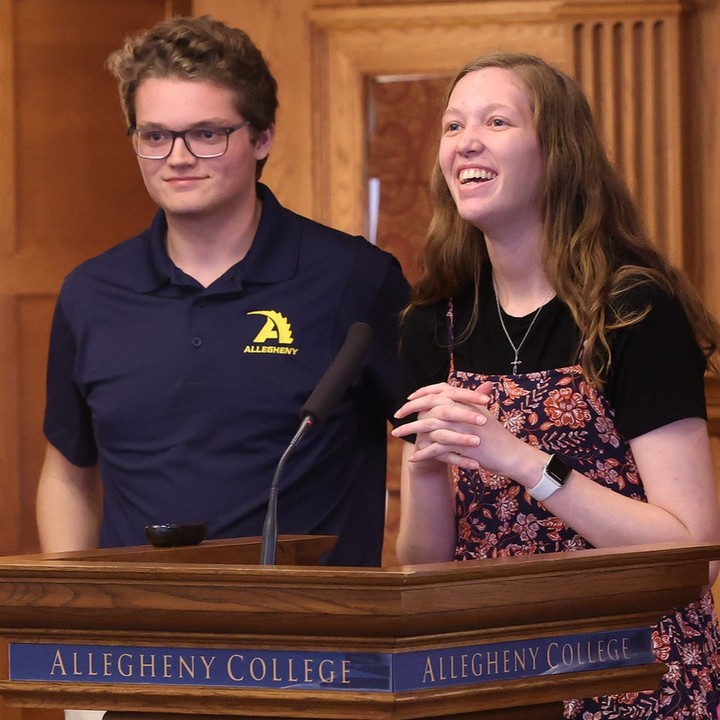
Emma Chambers '24 and Hans Vanderzyden '25 studied how a pair of orbiting black holes is affected by gas from stars that wander too close and are torn apart. Such systems can later send out gravitational waves detectable on Earth. Hans is now pursuing graduate studies at the Air Force Institute of Technology (AFIT), while Emma is pursuing her PhD in astrophysics at RIT.
Charles Gibson '25, a physics major with minors in astronomy and music performance, led our study of stripped stars from high-speed collisions (Gibson et al. 2025), work supported by an Illinois Space Grant and featured by the College. While an Allegheny student, he also performed regularly as a jazz pianist, held summer research internships at Northwestern University and Caltech, and developed skills in coding, scientific writing, presentations, Linux, GitHub, and high-performance computing. He is now an astrophysics PhD student at Northwestern University.
Katie McLendon '25 is now the Assistant Manager of the Buhl Planetarium at Kamin Science Center in Pittsburgh, where she helps teach visitors about the universe on a professional planetarium dome. Her senior project in my lab investigated whether stellar collisions could help form black holes in the so-called pair-instability mass gap. That work connected astrophysics, computation, visualization, and the effective communication of science, skills she now uses to make astronomy engaging for broad audiences.
Sarah Seitanakis '20 is now a Senior User Experience Designer for Fidelity Investments after working as a UX Designer and Research Engineer at CoVar. In my lab, she expanded, improved, and debugged our hydrodynamics code StarSmasher, including adding new physics needed to simulate encounters between stars and black holes. She has since applied that same combination of technical depth, careful problem solving, software development, data visualization, and clear communication skills to large-scale projects in industry.
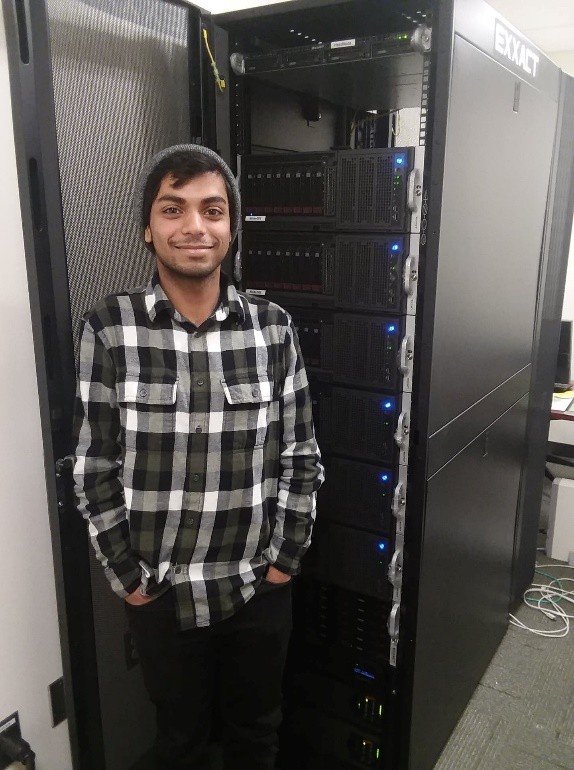
Dipto Mukherjee '19 went on to earn his PhD in astrophysics from Carnegie Mellon University, where he worked with stellar dynamics codes designed to exploit the computational power of GPUs. He now works for Apple as a GPU Machine Learning Engineer. In my lab, Dipto developed his skills using GPUs and helped build a Python interface to our StarSmasher hydrodynamics code, gaining experience that connected physics, high-performance computing, and software design.
Papers co-authored with undergraduates
Research in my group can lead to real, peer-reviewed publications. The papers below were co-authored by my students; Allegheny College undergraduates are shown in bold and marked with an asterisk (*). Each title links to the paper's abstract.
- Spin–Orbit Alignment in Merging Binary Black Holes Following Collisions with Massive Stars. Kıroğlu, Fulya; Lombardi, James C.; Kremer, Kyle; Vanderzyden, Hans D.*; Rasio, Frederic A. 2025, Astrophysical Journal Letters, 983:L9 (10 pp).
- Formation of Stripped Stars from Stellar Collisions in Galactic Nuclei. Gibson, Charles F. A.*; Kıroğlu, Fulya; Lombardi, James C.; Rose, Sanaea C.; Vanderzyden, Hans D.*; Mockler, Brenna; Gallegos-Garcia, Monica; Kremer, Kyle; Ramirez-Ruiz, Enrico; Rasio, Frederic A. 2025, Astrophysical Journal, 980:109 (19 pp).
- Partial Tidal Disruptions of Main-sequence Stars by Intermediate-mass Black Holes. Kıroğlu, Fulya; Lombardi, James C.; Kremer, Kyle; Fragione, Giacomo; Fogarty, Shane*; Rasio, Frederic A. 2023, Astrophysical Journal, 948, 89-103.
- Simulating a stellar contact binary merger - I. Stellar models. Hatfull, Roger W. M.*; Ivanova, Natalia; Lombardi, James C. 2021, Monthly Notices of the Royal Astronomical Society, 507, Issue 1, pp. 385-397.
- Tidal Disruptions of Stars by Black Hole Remnants in Dense Star Clusters. Kremer, Kyle; Lu, Wenbin; Rodriguez, Carl L.; Lachat, Mitchell*; Rasio, Frederic A. 2019, Astrophysical Journal, 881, 75.
- FluxE: exploring flux in astrophysical simulations. Wenskovitch, J. E.; Lombardi, J. C.; Hatfull, R. W. M.*. 2016, Proceedings of the SIGGRAPH ASIA 2016 Symposium on Visualization, article no. 15.
- Micro-tidal disruption events by stellar compact objects and the production of ultra-long GRBs. Perets, H. B.; Li, Z.; Lombardi, J. C.; Milcarek, S. R.*. 2016, Astrophysical Journal, 823, 113.
- An efficient radiative cooling approximation for use in hydrodynamic simulations. Lombardi, J. C.; McInally, W. G.*; Faber, J. A. 2015, Monthly Notices of the Royal Astronomical Society, 447, 25.
- Implications of the Delayed 2013 Outburst of ESO 243-49 HLX-1. Godet, O.; Lombardi, J. C.; Antonini, F.; Barret, D.; Webb, N. A.; Vingless, J.*; Thomas, M.*. 2014, Astrophysical Journal, 793, 105.
- Twin Binaries: Studies of Stability, Mass Transfer, and Coalescence. Lombardi, J. C.; Holtzman, W.*; Dooley, K. L.; Gearity, K.*; Kalogera, V.; Rasio, F. A. 2011, Astrophysical Journal, 737, 49-64.