Simulating Stellar Collisions
In crowded star clusters and near giant black holes, stars really do crash into each other. My students and I recreate those crashes on supercomputers.
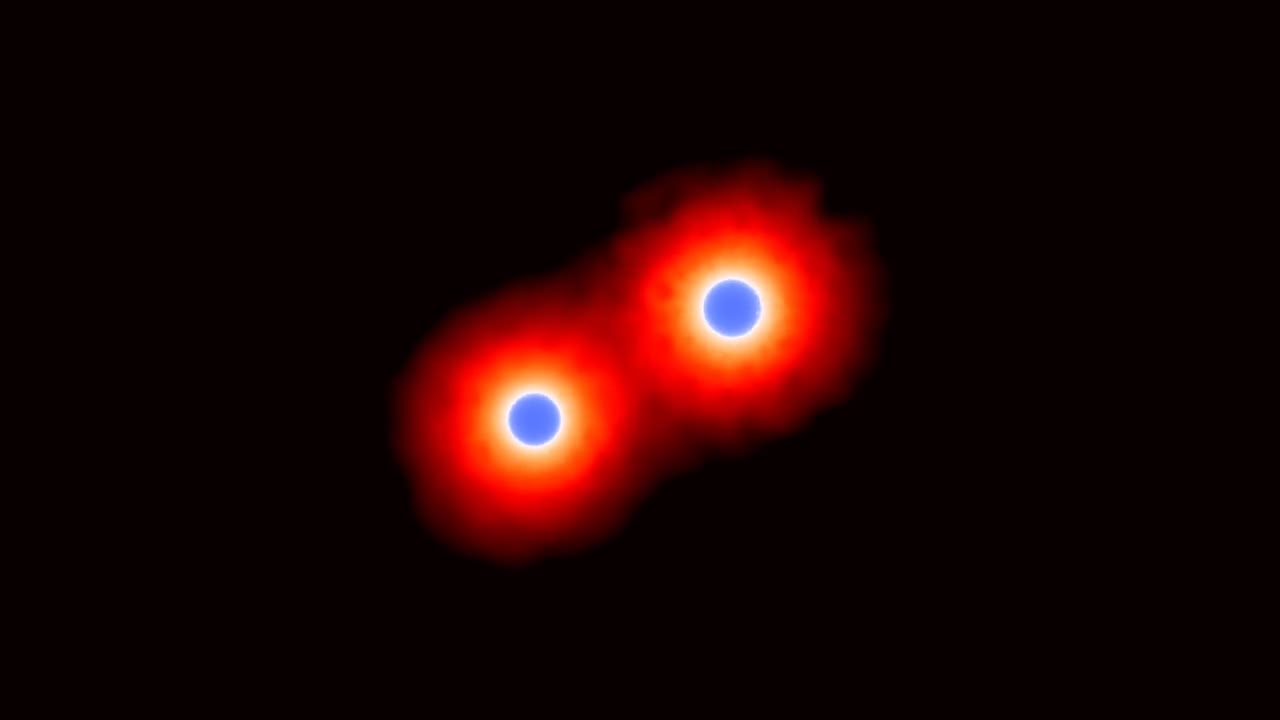
What we do
Our group studies what happens when stars get too close to each other. We use a technique called smoothed particle hydrodynamics, or SPH: a star is modeled as hundreds of thousands of fluid particles, and the computer follows every particle through the encounter as gravity and gas pressure fight it out. We can replay a collision from any angle, slow it down, and measure things no telescope ever could.
Around quiet neighborhoods like the Sun's, collisions essentially never happen. In the dense cores of globular clusters and near the supermassive black holes at the centers of galaxies, they are a fact of life, and the wreckage explains some of the strangest objects in the sky: "blue straggler" stars that look impossibly young, stars stripped of their outer layers, ultracompact X-ray binaries, and sources of gravitational waves.
A stellar collision unfolds over hours to days, and the chance of pointing a telescope at the right star at the right moment is essentially zero. Simulation is how we get to watch one. We build and share the SPH code StarSmasher for exactly this purpose. Modeling these collisions draws on stellar dynamics, stellar evolution, and hydrodynamics, all of which play important roles.
The science behind this work is collected in our recent papers, and much of it is done by Allegheny undergraduates. Interested students can explore research opportunities for students.
Software
StarSmasher is the SPH code behind our simulations, developed openly on GitHub and descended from the earlier StarCrash code. If you want to smash stars together yourself, start there.
collAIder is a machine learning tool that predicts the outcome of a stellar collision in an instant, with no new simulation required. Trained on the tens of thousands of SPH collisions behind González Prieto et al. 2026, it forecasts how many stars survive an encounter and what they look like afterward, fast enough to drop into large N-body models of dense star clusters.
Make Me A Star (MMAS) is an older, lightweight tool that builds a model of a collision product from two parent stars, developed with Jessica Sawyer Warren and released under the GNU GPL. Download: version 1.6.